Reducing Technical Debt in the Agile Process

This article is part of the Developer Survival Kit.
Practical solutions to win back your focus time and deliver real results instead of just playing along in the "Agile Theater."
Software development is a race against time. But often it feels like we're running with lead weights on our feet. Every new feature takes longer than the last, every bug fix rips open three new holes.
Welcome to the world of technical debt.
Whenever you as a developer try to get time for refactoring, you often hear:
"We don't have time for that right now; the business needs Feature X."
The problem: The business doesn't understand that it's already paying interest – in the form of decreasing velocity and increasing instability.
In this guide, you'll learn how to not just manage technical debt in the agile process, but how to communicate it so that even the most feature-driven Product Owner understands why we must pay it down.
The Metaphor: Paying Interest for Fast Code
The term "Technical Debt" was coined by Ward Cunningham (one of the fathers of the Agile Manifesto). The term is brilliant because it translates a technical problem into a language that management understands: money.
When we build a "quick and dirty" solution to meet a deadline, we take out a loan. That's okay, as long as we do it consciously. But like any loan, there is interest.
The interest: This is the extra effort we have to put in for every future ticket because we have to work around the ugly code.
The principal payment (repayment): This is the refactoring to make the code clean and maintainable again.
The problem: If we only take out loans and never repay them, the team will eventually become technically insolvent. We spend 90% of our time on bug fixes and interest payments and have 0% time for innovation.
The Technical Debt Quadrant (according to Martin Fowler)
To manage tech debt, you need to know what kind of debt you have. Martin Fowler divides it into four quadrants.
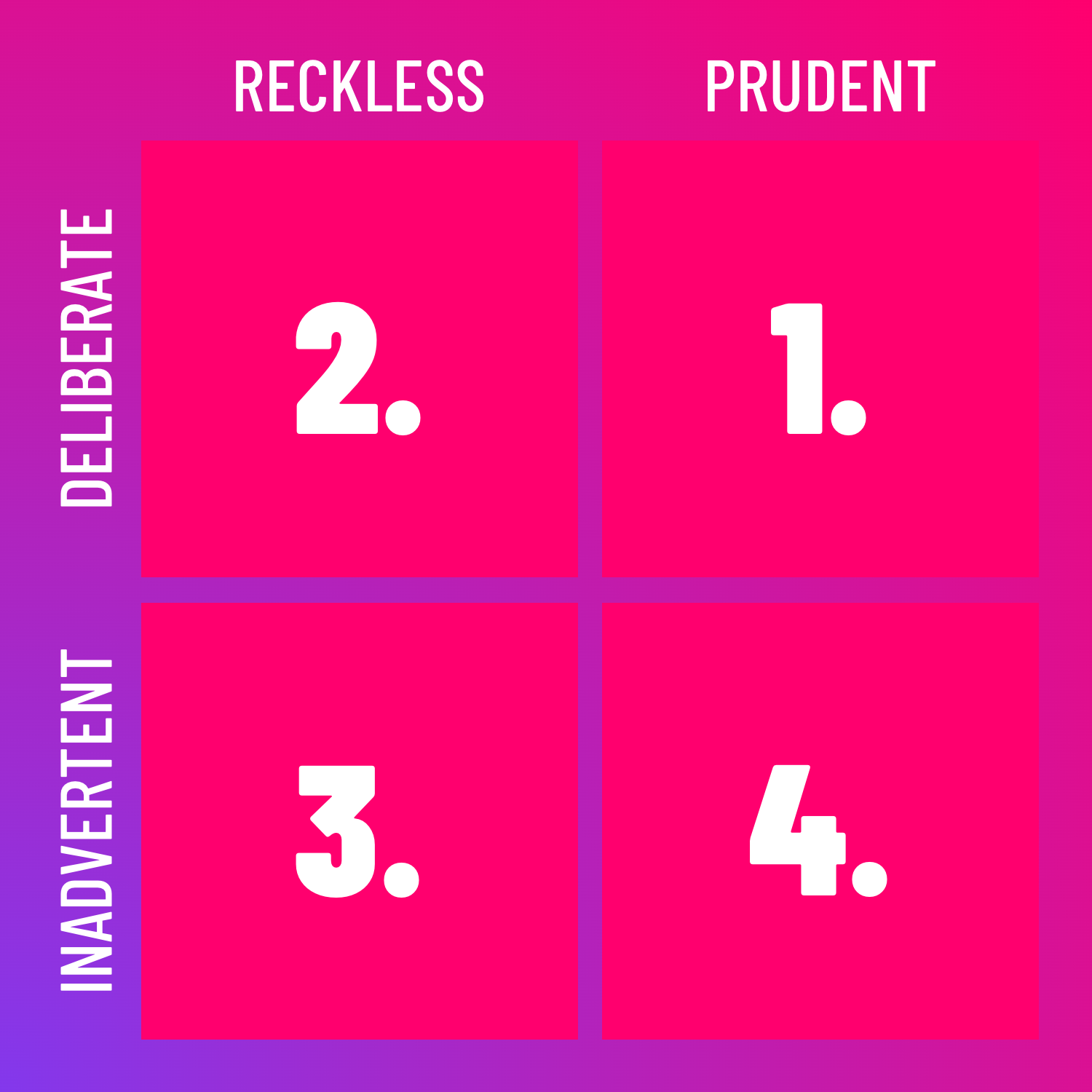
- Prudent & Deliberate: "We must release now and consciously accept the debt. We'll clean it up afterward." (The "good" loan).
- Reckless & Deliberate: "We don't have time for design, just slap something together." (The dangerous loan).
- Reckless & Inadvertent: "What's a design pattern anyway?" (The team doesn't know any better – only training helps here).
- Prudent & Inadvertent: "Now that we're finished, we know how we should have built it." (Inevitable – you learn while coding).
Related: Why Story Points often lead to technical debt – Read the article on Story Point Nonsense here.
Why "Refactoring Sprints" usually fail
"Let's go full throttle for the next three sprints, and after that, we'll do a refactoring sprint."
This is the biggest lie in software development. Refactoring sprints almost always fail for two reasons:
Prioritization: As soon as the refactoring sprint is due, a "Prio-1 customer request" comes in. Management will always be the first to cut a sprint that has no direct business value.
Isolation: Refactoring without context is hard to justify. Cleaning up code that won't be touched anyway is a waste.
Therefore: Refactoring must be a continuous process, not an event. If you try to pay down tech debt only in "bulk," it's usually already too late.
The Boy Scout Rule: Leave code cleaner than you found it
The only sustainable strategy against tech debt is the Boy Scout Rule.
"Always leave the code a little bit cleaner than you found it."
This means for your sprint:
When you work on a bug ticket, you clean up the ugly method right next to it. This "micro-refactoring" can also be part of your Definition of Done (DoD). You don't ask for permission for unit tests or clean variable naming – that is your professional standard. If you consider refactoring as an integral part of the story estimate, it becomes invisible (and thus untouchable) to management. It's simply the way you work.
Visualizing Tech Debt in the Backlog
Sometimes the debt is so large that the Boy Scout Rule is no longer enough. If you have to replace an entire architectural component, you need visibility.
The trick with "Red Tickets"
Put technical debt as real items into the Product Backlog. Mark them in color (e.g., Red). For the naming, here's a small trick: Don't call the task "Refactoring the Database Class" (the PO only hears: "Gold-Plating"). Instead, call it "Risk Mitigation: Reducing Latency and Fixing Errors in the Checkout Process." As soon as a technical debt has its own card in the backlog, the PO must actively decide: "Do I ignore this risk (and continue paying high interest) or do I invest in the future?"
Negotiation Strategies with the Product Owner
As developers, we tend to argue technically ("the coupling is too high"). Your PO, however, thinks in terms of opportunity costs. To get time for tech debt, you must speak their language. Here are several arguments you can put forward:
The Time Argument: "If we don't clean up this component now, all future features in this area will take twice as long. We'll lose our time-to-market."
The Risk Argument: "This code section is extremely unstable. If we don't stabilize it, we risk unpredictable system failures during peak season."
The Recruiting Argument: "Good developers don't want to work in a digital landfill. If we ignore quality, it will be harder to find new people or keep the current ones."
Tip: Use the Retrospective to make the pain caused by tech debt measurable. Point out how many story points you lost in the last sprint due to "interest payments" (unnecessary debugging).
🏗️ Negotiating Tech Debt: Your Economic Argumentation Guide
Stop talking about "beautiful code." Talk about money, time, and risk:
| Management says... | Your response as a Pro Dev |
|---|---|
| "We don't have time for that; the business needs Feature X." | "Exactly because the business needs Feature X fast, we must clean up Module Y. If we don't pay down the interest on the technical debt there, Feature X will take twice as long as planned. Do we want to invest today or be slowed down tomorrow?" |
| "Can't we just do a quick fix?" | "A quick fix is a loan with extremely high interest. If we do that today, we must immediately schedule a ticket for repayment in the next sprint. Otherwise, we risk a system failure when the load increases next month." |
| "Why is refactoring so expensive?" | "Refactoring is not expensive; it's necessary maintenance. It's like an oil change for a car: You can ignore it to save $100 – until the engine failure costs you $5,000. We are currently protecting the value of our product." |
Conclusion: Quality is an economic decision
Technical debt is inevitable, but it must not grow unchecked. An agile process is not a license for sloppiness. On the contrary: only those who keep their code clean stay agile in the long run. Learn to see tech debt not as a "developer problem," but as an economic risk for the product. Those who don't pay their interest will eventually be overtaken by the competition, which can deliver faster because their code doesn't hinder them.
What's Next?
Technical debt is often just a symptom. The cause is usually a system that "starts" more work than it "finishes." Understand the physics behind your workflow.
🛡️ Next Step: Flow Physics: Why Utilization is the Enemy of Speed
🏠 Back to Overview: The Agile Survival Kit for Developers
Did this guide help you?
Share it with your team or discuss it with me on Mastodon. Real feedback helps me make this content even better for devs!
Mastodon Diskussionen
You may also like:

The "Agile" label is burnt. Agile work as a craft is just getting started.
If the label "Agile" carries so much baggage...
Are Story Points Nonsense? The Truth About Agile Estimation
This article is part of the Developer Survival...