Forget "Agile" Theory: The Only Cycle That Really Matters
Have you ever wondered why we are actually putting on this whole circus?
We trudge to Dailies, we estimate Story Points like fortune tellers at a fair, and we fill Jira boards beyond recognition. But at the end of the day, it still takes months for a line of code to reach the actual user.
We have lost ourselves in framework discussions. We argue about SAFe vs. Scrum while our craft is rotting. It is time to end the "Agile Theater" and focus on what Agile Working actually is at its core.
It is exactly two terms: Work and Feedback.
The Core: A Merciless Cycle
If we strip away all the baggage – the certificate mills, the role descriptions, and the rituals – this is what remains.
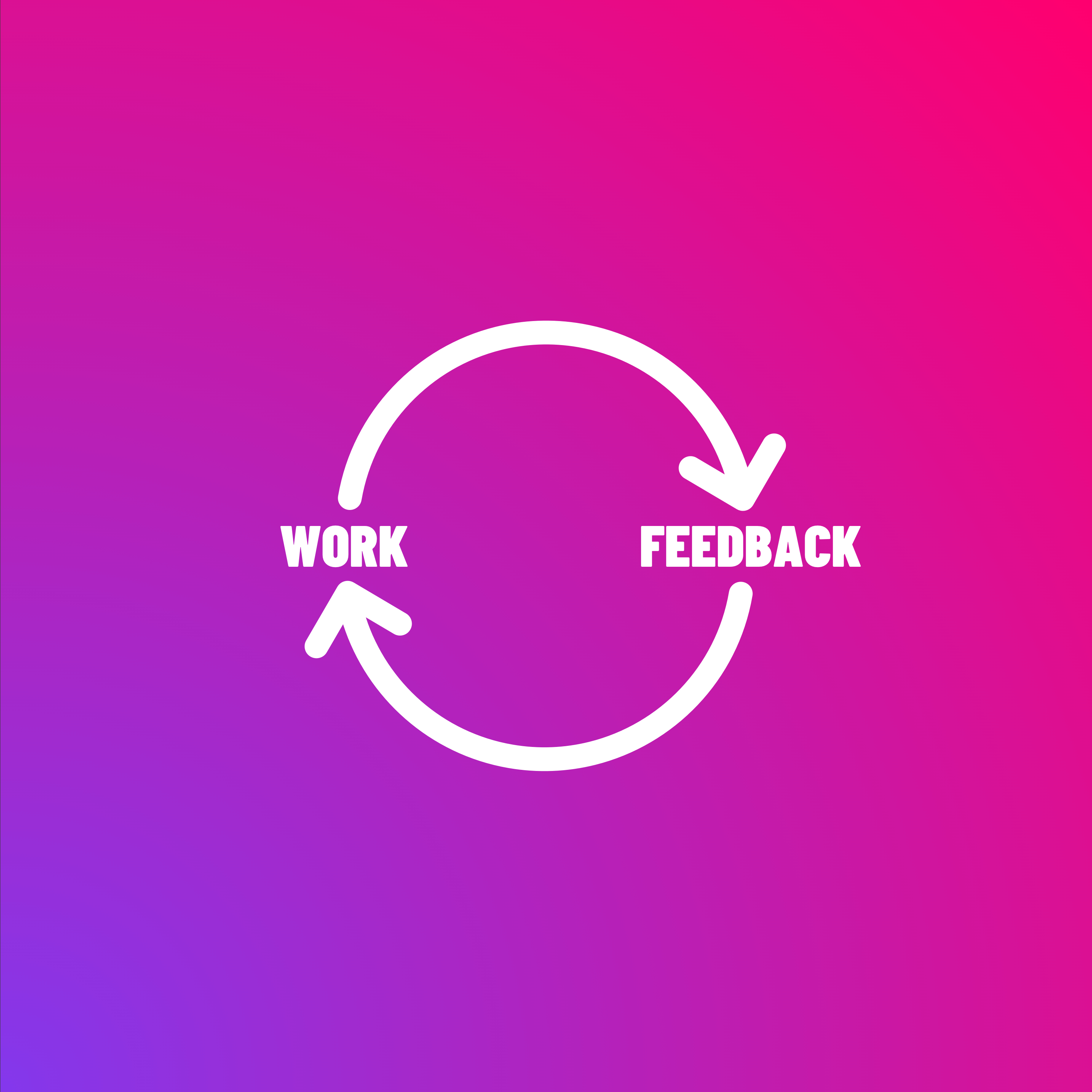
That is all. Agile Working is not a management concept, but an economic survival strategy in a complex world. We build something functional (Work), we let it collide with reality (Feedback), and we adjust our course based on what we have learned.
The golden rule is: Your agility is not measured by the number of your certificates or lines of code, but by the speed of this cycle.
Speed is Nothing Without Guardrails
„If we just code faster, the system will collapse!“
Correct. If you just blindly step on the gas, you will end up in the ditch sooner. When I say we need to accelerate this cycle, I don't mean "hectic." I mean the technical and organizational ability to learn quickly without sacrificing quality, security, or user experience.
To make this cycle fast and stable, we don't need new meetings. We need Skills.
The Tool Wall of the Craft
To shrink the Work-Feedback Cycle from three months to three weeks (or three hours), we have a whole wall of tools at our disposal. What you see here in the graphic is not even complete. Neither in the major themes, nor in the individual elements per theme. But that is not what matters anyway.
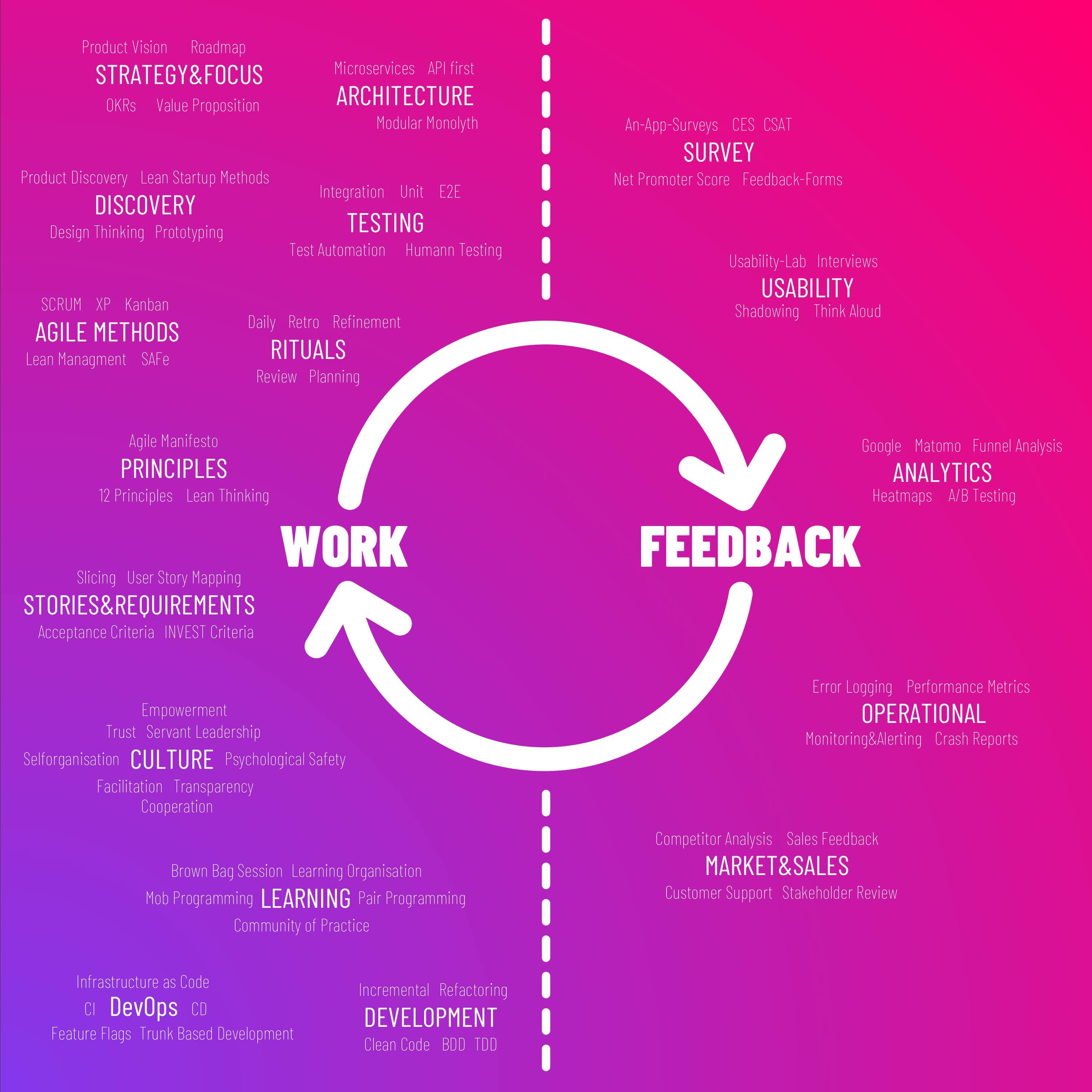
To truly accelerate the cycle, we must work on both areas simultaneously: We must increase the quality of our work (Work) so it can flow safely, and we must professionalize our channels for learning (Feedback).
1. The Left Side: Work (Building with Confidence)
The left side of the graphic comprises everything we do before and while we write code. These points (from architecture to rituals) have a common goal: to make the output as stable and precise as possible. We divide them into three levers:
- The technical foundation (Architecture, Development, Testing, DevOps): This is about defeating fear. Modularity and automation are not religious prescriptions, but technical risk management. They ensure that we are even capable of producing changes on an assembly line without the system blowing up in our faces.
- The content direction (Strategy, Discovery, Stories & Requirements): We use Product Discovery and radical slicing to avoid "running faster in the wrong direction." Good preparation makes work units small and thus the entire cycle short.
- The social operating system (Culture, Learning, Agile Methods & Rituals): Psychological safety and continuous learning are the lubricants. Without them, work gets stuck in silos or in the fear of making mistakes. Methods and rituals are only a means to an end here, not an end in themselves.
2. The Right Side: Feedback (Ending the Guesswork)
The right side ends the blind flight. Once the work is "out there," the most important part begins: the reality check.
- The human voice (Usability & Survey): We don’t wait three months to know if a feature is understood. Usability labs and direct user feedback are the early warning systems that protect us from expensive misdevelopments.
- The hard reality (Analytics & Operational): Numbers don’t lie. Whether through Matomo, error logging, or performance metrics – this is where we get feedback directly from the system. Those who ignore this data aren't working agily, they are working hopefully.
- The economic proof (Market & Sales): In the end, the market decides. Feedback from sales and competitor analysis tell us whether our work has actual economic value or was just "feature trash."
Important Note: A team should never try to implement everything at once. Use this map as a tool wall: pick the 1-2 measures that have the greatest leverage in your current situation to noticeably shorten the cycle TODAY.
All of this aims at delivering the smallest possible, valuable increments and checking if they create real value. The collected feedback on the increment then flows back into the planning for the next increments. This way, we manage to deliver the right thing at any time. "Right" here simply means: what brings a benefit to the user of the system.
So it sounds very logical that we want to concentrate on this cycle and accelerate it as much as possible. Entirely in the interest of the user.
Your Strategy: Pick your Battles (The 80/20 Rule)
The biggest mistake organizations make: they try to "introduce" a framework. They buy the whole menu when they actually just need a glass of water.
Stop trying to "be agile." Start analyzing your pain. Use the map above like a compass:
- Identify the bottleneck: Where do you lose the most time? Does testing take two weeks? Then your construction site is "Testing" (Unit Tests, Automation). Do you have no idea if the users like the feature? Then your construction site is "Analytics" or "Surveys."
- Choose the smallest measure: Pick the things that cost little effort but immediately shorten your feedback cycle (the "Low Hanging Fruits").
- Measure instead of believing: Measure your Cycle Time. How long does it take from the idea to the feedback? If a measure does not shorten this time, it is baggage.
Conclusion: Back to the Workshop
2026 is the year we stop discussing agility as a religion. We must perceive it again as what it is: a craft.
Agile Working requires technical judgment, economic sanity, and the courage to leave gaps. A team that masters its Work-Feedback Cycle doesn't need a 500-page framework manual. It just needs the right skills.
The label is burnt. The work begins.
Welcome to the workshop.