Diagnosis Matrix: Why Work Systems Don’t Learn
If a system isn’t learning, it’s usually not because of a lack of will, missing mindset, or missing methods. It’s because work and feedback are not coupled fast enough. That happens more often than people think.
This matrix helps you see where exactly that breakdown occurs.
The two questions this is about
Every working system can be described with two simple questions:
- How fast and how safely can we change real work?
- How fast and without distortion do we get feedback from reality?
The Diagnosis Matrix
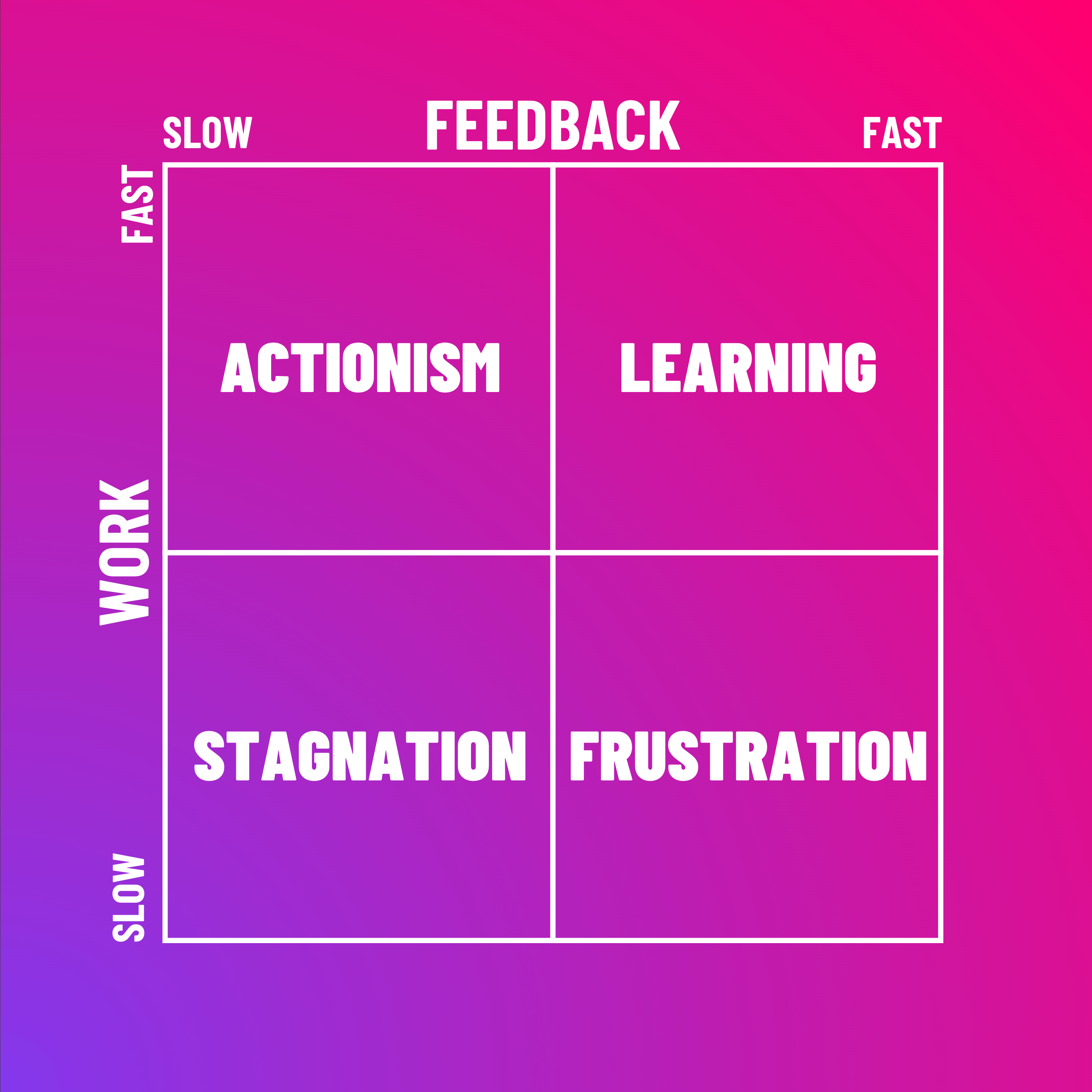
The Work–Feedback Loop exists in every system. The question is not whether it exists, but how fast it is actually run.
The four quadrants
1) Fast Work × Fast Feedback → Learning
This is where the system actually learns.
- Work is small, changeable, reversible
- Feedback arrives early and comes from reality
- Mistakes are cheap
- Decisions can be corrected
Typical signals
- Short cycle times
- Releases are boring — not an event
- Little debate about “what we should have done”
Diagnosis
The system learns.
Important: In this situation, don’t optimize and don’t scale. The motto is: protect it.
2) Fast Work × Slow Feedback → Actionism
A lot happens here — but little learning.
- Things get delivered
- Things get built
- But it becomes clear very late whether it works. The coupling is missing.
Typical signals
- Many deployments
- High activity
- Surprises are discovered late
- More discussion than signal capture and analysis
Common misconception
“But we’re fast.”
Real cause
Feedback enters the system too late — or filtered.
Levers
- Inspect and improve instrumentation
- Institutionalize or expand usage and production feedback
- Create a shorter path to reality
3) Slow Work × Fast Feedback → Frustration
You know a lot here — but you can’t change much.
- Feedback exists and is captured systematically
- But changes are expensive, risky, or politically blocked
Typical signals
- “We know exactly what’s wrong”
- Large releases
- High fear of change
- Stagnation despite insight
Common misconception
“The organization is blocking us.”
Real cause
Work is not changeable enough.
Levers
- Improve architecture
- Reduce batch sizes
- Create technical safety
- Make decisions reversible
4) Slow Work × Slow Feedback → Stagnation
Learning is being simulated here.
- A lot of busyness
- Many meetings
- Many roles
- Little real impact
Typical signals
- Programs, initiatives, “transformations”
- New vocabulary, same outcomes
- No clear feedback loop
Common misconception
“We need a new framework.”
Real diagnosis
Cause and effect are decoupled.
Levers
Focus on closing one real loop. Start small. Measure honestly. If the loop doesn’t get faster, stop.
Key insight
This matrix leads to an uncomfortable truth:
Slow feedback is almost always a work problem.
Fast work without feedback is self-deception.
A system learns only where work and feedback are fast at the same time.
How to use the matrix
Don’t use it to judge. Use it to locate yourself honestly. Pick one quadrant, not all four. Improve one axis, not everything at once. And above all:
Never improve work or feedback in isolation. Close the loop.
Back to the core
This matrix doesn’t replace thinking. It forces it — by making you look at what your work–feedback loop actually does.
If you want to understand why the loop is the core, read: